
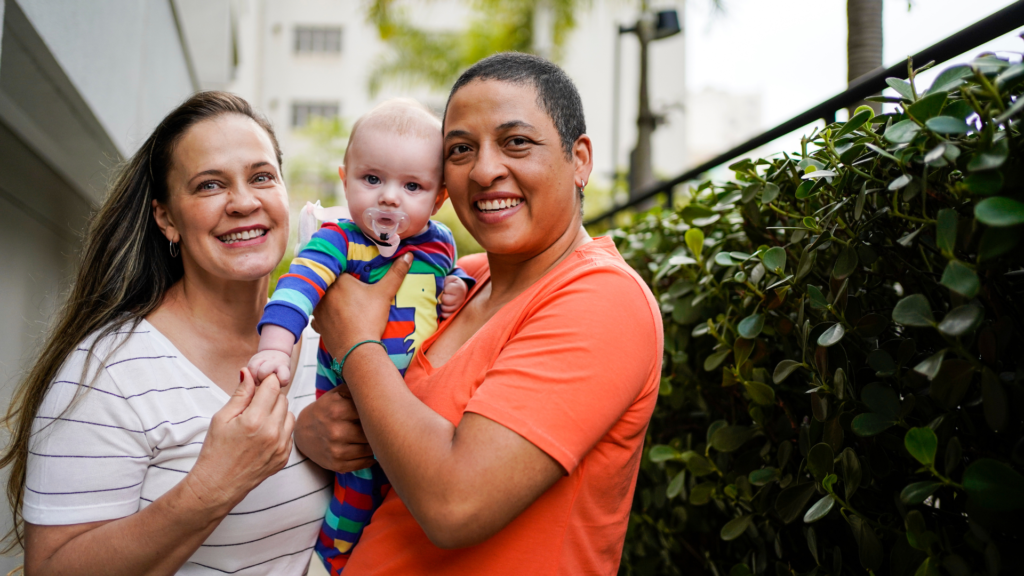
Photo by Renata Angerami with Getty Images
Who Gets to Have a Family? Barriers to Fertility Care for LGBTQ+ Families in the United States
The right to form a family is widely recognized as fundamental, based on the rights to access to sexual and reproductive health care and bodily autonomy. Yet, despite these universal protections, couples who fall outside narrow definitions of family and reproduction face significant barriers to building a family of their own. In the United States, same-sex couples face unique and disproportionate challenges in accessing fertility care due to legal and systemic barriers. These barriers stem from two central issues:
Gaps in legislation and normative regulation
Despite the fact that the legal right to marry presents a strong association to the right to start a family, and that the court’s decision determined that family and marriage matters are private and not state-based determinations, Mech (2017) clarifies that Obergefell did not create any “positive right to parent children” (354). This means that while it is an implicit constitutional right, it is not an explicit protection that the federal state guarantees. Furthermore, James (2020) explains how Pavan v Smith in 2017 “clarified [that] states must give spouses in same sex marriages the same benefits and protections they give spouses in opposite sex marriages” (269). This gap in federal legislation leaves it up to the states’ discretion to protect same-sex reproduction.
Notably, only nineteen states have worked to expand their legislation to include reproductive care in their insurance coverage. Within this, only eight states explicitly require the inclusion of IVF treatments in insurance coverage (Ho et al., 2021), and only thirteen states name “sperm donors, artificial insemination, or both” (James 2020).
Gaps in healthcare financial accessibility
Assisted reproductive technologies (ART) provide key solutions for individuals experiencing biological or social infertility. For same-sex couples, ART is often the only viable pathway to biological parenthood. However, these services are highly expensive. IVF can cost between $12,000 and $15,000 per attempt, with success rates often requiring multiple cycles, while surrogacy can exceed $100,000 (Neyra, 2021). As a result, access to reproductive care is largely dependent on insurance coverage.
The Invisibility of Social Infertility
Structurally, both legislative and health coverage issues are tied to the invisibility of social infertility. Biological infertility is typically defined as the inability to conceive after 6 to 12 months of unprotected intercourse (James, 2020; Richburg et al., 2022). For same-sex couples, who cannot biologically reproduce together, this definition is inherently exclusionary. No amount of time spent attempting to conceive will meet this standard. This has come to be defined as social infertility, and continues to be largely unrecognized in healthcare insurance policy and federal protection frameworks (Richburg et al., 2022; Letterie, 2023).
These barriers are further intensified by broader socioeconomic inequalities. LGBTQ+ individuals face higher rates of discrimination across employment, housing, and healthcare systems. According to a study conducted by Casey et al., for the Health Services Research Journal in 2019, many queer individuals have reported avoiding healthcare altogether due to anticipated stigma, with more than one in six LGBTQ+ adults reporting avoidance of care due to discrimination.
At the same time, the structure of the healthcare system in the U.S further exacerbates these disparities. Fertility care is largely privatized, leaving its access as a result of financial capacity rather than medical need, which further affects those who disproportionately face barriers to healthcare access. For instance, in her research of surrogacy clinics for male same-sex couples, Jacobson (2018) found that out of 444 surveyed clinics, 151 appeared to be ‘gay-friendly’ or ambiguous, with only 80 explicitly included specific promotional content for gay men, while the other 273/444 did not actively display any LGBTQ+ friendly promotional or recruitment content on their sites (18).
Legal protections do little to resolve these issues. While Obergefell v. Hodges secured the right to marriage, it did not extend to guaranteeing equitable access to family-building (Mech, 2017). Instead, reproductive care is governed by a patchwork of state-level policies, narrow medical definitions, and market-based access (Ho et al., 2021).
Overall, inconsistent state-wide laws on reproductive care for LGBTQ+ couples and the absence of comprehensive anti-discrimination protections that ensure fertility care regardless of identity factors severely restrict their access to reproductive health services. These social, economic, and legal inequalities to accessing care are representative of the broader social and economic structural barriers within a system that fundamentally excludes non-traditional forms of family-planning.
Further recommended reading & sources:
Boulet, S. L., Kawwass, J., Session, D., Jamieson, D. J., Kissin, D. M., & Grosse, S. D. (2019). US State-Level Infertility Insurance Mandates and Health Plan expenditures on infertility treatments. Maternal and Child Health Journal, 23(5), 623–632. https://doi.org/10.1007/s10995-018-2675-y
Casey, L. S., Reisner, S. L., Findling, M. G., Blendon, R. J., Benson, J. M., Sayde, J. M., & Miller, C. (2019). Discrimination in the United States: Experiences of lesbian, gay, bisexual, transgender, and queer Americans. Health Services Research, 54(S2), 1454–1466. https://doi.org/10.1111/1475-6773.13229
Gray, B. H. (1986). Special Report on For-Profit enterprise in health care. In National Academies Press eBooks (Vol. 314). Institute of Medicine (US) Committee on Implications of For-Profit Enterprise in Health Care. https://doi.org/10.17226/653
Ho, J. R., Aghajanova, L., Mok-Lin, E., Hoffman, J. R., Smith, J. F., & Herndon, C. N. (2021). Public attitudes in the United States toward insurance coverage for in vitro fertilization and the provision of infertility services to lower income patients. F&S Reports, 3(2), 122–129. https://doi.org/10.1016/j.xfre.2021.09.002
Letterie, G. (2023). What is the status of insurance coverage for fertility services in the United States by large insurers? A patchwork system in need of repair. Journal of Assisted Reproduction and Genetics, 40(3), 577–580. https://doi.org/10.1007/s10815-023-02741-y
Mech, C. (2017). Same-Sex Marriage and the Baby Carriage: A Post-Obergefell analysis of ART Funding for Same-Sex Couples in the United States. The Georgia Journal of International and Comparative Law, 45(2), 343. https://digitalcommons.law.uga.edu/cgi/viewcontent.cgi?article=2395&context=gjicl
National Academies of Sciences, Engineering, and Medicine. 2017. Communities in Action: Pathways to Health Equity. Washington, DC: The National Academies Press. https://doi.org/10.17226/24624.
Neyra, O. (2021). Reproductive ethics and family. Voices in Bioethics, 7. https://doi.org/10.52214/vib.v7i.8559
Perritt, J., & Eugene, N. (2021). Inequity and injustice: recognizing infertility as a reproductive justice issue. F&S Reports, 3(2), 2–4. https://doi.org/10.1016/j.xfre.2021.08.007
Richburg, C. E., Levin, N. J., & Moravek, M. B. (2022a). Laboring to Conceive: Reducing Barriers to Fertility Care for Same-Sex Mothers Pursuing Parenthood. Women, 2(1), 44–55. https://doi.org/10.3390/women2010005
Sileo, K. M., Baldwin, A., Huynh, T. A., Olfers, A., Woo, J., Greene, S. L., Casillas, G. L., & Taylor, B. S. (2022). Assessing LGBTQ+ stigma among healthcare professionals: An application of the health stigma and discrimination framework in a qualitative, community-based participatory research study. Journal of Health Psychology, 27(9), 2181–2196. https://doi.org/10.1177/13591053211027652
Tam, M. W. (2021). Queering reproductive access: reproductive justice in assisted reproductive technologies. Reproductive Health, 18(1). https://doi.org/10.1186/s12978-021-01214-8
UN General Assembly, International Covenant on Economic, Social and Cultural Rights, United Nations, Treaty Series, vol. 993, p. 3, 16 December 1966, https://www.refworld.org/legal/agreements/unga/1966/en/33423
UN General Assembly, Convention on the Elimination of All Forms of Discrimination Against Women, United Nations, Treaty Series, vol. 1249, p. 13, 18 December 1979, https://www.refworld.org/legal/agreements/unga/1979/en/13757
UN Population Fund (UNFPA), Report of the International Conference on Population and Development, Cairo, 5-13 September 1994, A/CONF.171/13/Rev.1, 1995, https://www.refworld.org/reference/themreport/unfpa/1995/en/68255
World Health Organization (WHO). (2014). Framework for ensuring human rights in the provision of contraceptive information and services. In Guidelines Review Committee, Sexual and Reproductive Health and Research (SRH) (978 92 4 150674 8). https://iris.who.int/bitstream/handle/10665/133327/9789241507745_eng.pdf